Skip to Main Content
🔒 Private⏰ 10 AM-6 PM📹 Video, audio or chat

Diabetic Retinopathy:
Symptoms, Eye Checks and Diabetes Care from ₹500

If you have diabetes and worry about your eyes, you are in the right place. Understand the warning signs, when to get your eyes checked and how better diabetes control protects your vision. Then talk to a diabetologist online, with a fixed fee of ₹500.

👁 Eye symptoms🩹 Blood sugar control📅 Yearly eye exam🧪 HbA1c💉 Treatment options🏠 Care from home
₹500
Per consultation
1 hr
Usual time to connect
10–6
Daily hours
3 ways
Video, audio or chat
Book a Diabetologist Consultation
Connects within 1 hour · 10 AM to 6 PM · Confidential
🔒 Privacy note: What you share is used only to arrange your consultation and is not shared without your consent.
Consultation Fee
₹500
10 AM to 6 PM rate
🔒 Confidential· Emergencies: call 112
Request received
Please complete payment to confirm your consultation.
Private & confidential
Nothing shared without consent
Qualified professionals
Ask for registration details any time
Video, audio or chat
From anywhere in India
Fixed fee ₹500
Shown before you pay
When to get urgent help
If your vision changes suddenly or becomes blurry, spotty or hazy, contact a doctor right away. Go to an eye hospital or the nearest casualty, or call 112. Do not wait for an online appointment slot.
👁 Understanding the condition

What Is Diabetic Retinopathy and How Does It Affect Your Eyes?

Diabetic retinopathy is a complication of diabetes that affects the eyes. High blood sugar damages the blood vessels in the retina, the light-sensitive tissue at the back of the eye. It can cause floaters, blurred vision or vision loss, but early on it may cause no symptoms at all.
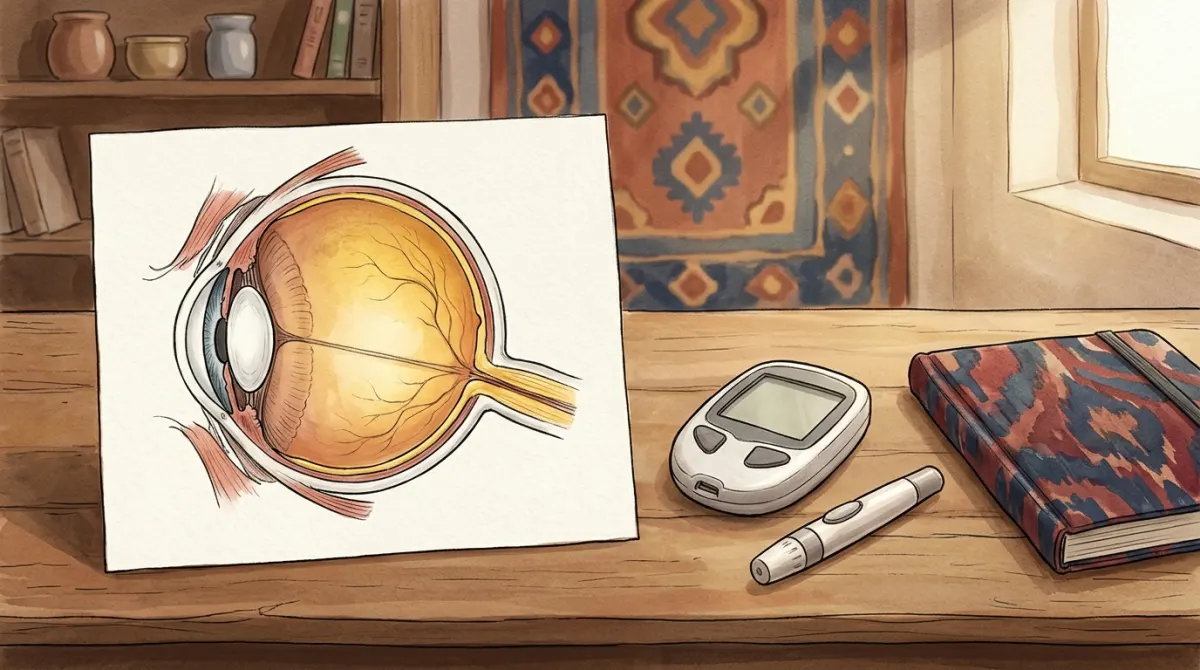
Illustration of the eye with its retina highlighted beside a glucose meter and notebook
The retina at the back of the eye can be damaged by long-term high blood sugar.

Diabetic retinopathy is a complication of diabetes that affects the eyes. It is caused by damage to the blood vessels in the retina, the light-sensitive tissue at the back of the eye. Because the retina is central to how you see, damage there can change your vision, sometimes slowly and quietly.

Long-standing high blood sugar is what harms these small blood vessels. Anyone with any kind of diabetes can be affected, including people with type 1, type 2 and gestational diabetes. It is a different problem from needing spectacles. Glasses correct how light focuses, but they cannot repair damage inside the retina.

The tricky part is that early on, this eye disease may cause no symptoms or only mild vision problems. Your eyesight can feel normal while changes are already starting. That is why a dilated eye exam every year is recommended even when your vision seems fine.

The good news is that diabetes does not always lead to vision loss. Managing your diabetes well can help stop problems. You usually need two kinds of doctors. A diabetologist manages your blood sugar and overall care. An eye doctor examines and treats the eye itself.

Quick Facts: Diabetic Eye Disease
What is affected
The blood vessels in the retina, at the back of the eye
Who can get it
People with type 1, type 2 or gestational diabetes
Early stage
May cause no symptoms or only mild vision problems
Eye exam
A dilated eye exam every year is recommended, even if vision seems fine
HbA1c test
Shows your average blood sugar over the previous 2-3 months
In India
Ayushman Bharat includes annual screening at primary health centres using fundus cameras
🧑‍⚕️ Who to see

Diabetologist vs Eye Doctor vs Primary Health Centre Screening: Who Does What?

You need both blood sugar care and eye care. Each one does a different job.

Diabetologist (online)
Looks after your blood sugar and overall diabetes plan. Reviews your readings and HbA1c, and can prescribe medicines at the doctor's discretion. Cannot examine the inside of your eye online.
Eye doctor (ophthalmologist, in person)
Does the dilated eye exam and decides on any eye treatment, such as injections, laser or surgery. Choose this doctor for yearly checks and for any vision change.
Primary health centre screening
Under Ayushman Bharat, annual population-based screening for retinopathy using non-mydriatic fundus cameras is part of the eye care package at primary health centres. It is a useful first check where available.
Psychologist or psychiatrist
Living with a long-term condition or worry about vision can be stressful. Psychologists offer talk therapy but do not prescribe. Psychiatrists are doctors and can prescribe when needed.
🩹 Signs, tests and care

Diabetic Retinopathy: Warning Signs, Eye Tests and Treatment

What to watch for, what the eye doctor checks, and how your diabetologist fits in.

Section 01 of 8

Early Warning Signs of Diabetic Retinopathy

Early retinopathy is often silent, so the absence of symptoms does not mean your eyes are healthy. When symptoms appear, they can include blurred vision or dark areas. You might also see spots or dark strings called floaters. Vision loss can also happen. Any of these deserves a prompt eye check. A sudden change, or vision that becomes blurry, spotty or hazy, needs medical attention right away.

  • Floating spots or dark strings in your sight
  • Blurred or hazy vision
  • Vision that seems different from before
  • Dark or empty patches in your field of view
  • Loss of vision in one or both eyes
  • Sudden change of any kind: seek care the same day
Signs to watch for
Floaters: spots or dark strings drifting in your sight
Blurred vision that comes and goes
Any change in how clearly you see
Dark or empty areas in your vision
Loss of vision, partial or complete
Good to Know
No symptoms does not mean no damage. Keep your yearly dilated eye exam even when you see perfectly well.
Section 02 of 8

Who Can Get Diabetic Eye Disease?

Anyone with any kind of diabetes can develop retinopathy. This includes type 1, type 2 and gestational diabetes. It develops because high blood sugar damages the small blood vessels in the retina. This is why steady blood sugar management matters so much for eye protection. If you are pregnant and have diabetes, tell both your doctors. This ensures your eye checks are planned properly for your situation.

Key points
Type 1, type 2 and gestational diabetes can all affect the eyes
High blood sugar is what harms retinal blood vessels
Having diabetes does not mean you will lose vision
Managing diabetes well can help stop problems
Pregnant women with diabetes should ask about eye checks
Good to Know
If you also have nerve symptoms such as tingling in the feet, read about diabetic neuropathy, another complication your diabetologist can review.
Section 03 of 8

How Is Retinopathy Checked? The Dilated Eye Exam

Eye doctors check for retinopathy as part of a dilated eye exam. The exam is simple and painless. Your doctor puts in eye drops to widen your pupil so the back of the eye can be seen clearly. A routine vision or spectacle test alone is not the same, as it does not look at the retina. Phone apps and online vision tests cannot replace this exam, so it has to be done in person.
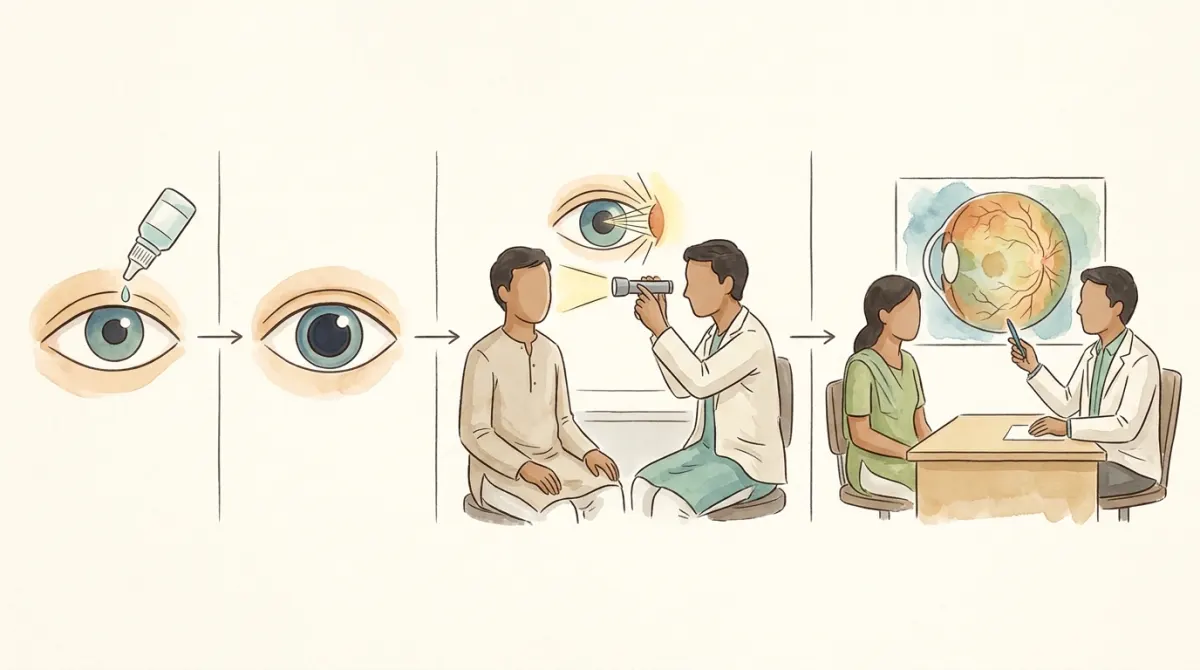
Diagram of the steps in a dilated eye exam for people with diabetes
A dilated eye exam is simple and painless.
  1. Book with an eye clinic — Choose a clinic or hospital near you that does dilated eye exams.
  2. Get the drops — Drops widen your pupil so the retina can be seen.
  3. Retina examination — The doctor looks at the back of your eye. It is painless.
  4. Plan the follow-up — Ask how soon to return and share the findings with your diabetologist.
How often to check
Every year at minimum, even if vision seems fine
Some people need an exam every 2 to 4 months
Your eye doctor decides your schedule
Check sooner for any new or sudden symptom
Good to Know
Bring someone with you if you can. Ask the eye doctor to write down your findings and your next check date.
Section 04 of 8

How a Diabetologist Helps Protect Your Eyes

Retinopathy starts with damage from high blood sugar, so controlling diabetes is a key part of protecting your eyes. A diabetologist reviews your sugar readings and your HbA1c, looks at your overall plan and adjusts it where needed. Any medicine is only on a doctor's prescription, at the doctor's professional discretion under India's Telemedicine Practice Guidelines. An online consultation does not replace the eye exam. It works alongside it.

What can be done online, and what needs an in-person visit
NeedOnline with a diabetologistIn person
Review of sugar readings and HbA1cYesNo
Diabetes plan and prescription changesYes, at the doctor's discretionNo
Dilated eye examNoYes, at an eye clinic
Injections, laser or eye surgeryNoYes, with an eye specialist
Key points
Sugar control is the part you can work on every day
Your doctor reviews HbA1c and home readings
Any medicine change is made by the doctor only
Share your eye doctor's findings with your diabetologist
Good to Know
Our online consultations are not for emergencies. Sudden vision change needs an eye hospital or casualty visit, not a chat booking.
Section 05 of 8

Treatment for Diabetic Retinopathy: What Eye Specialists Offer

Treatment is decided by an eye specialist after examining your eyes, and it depends on how far the problem has gone. Options include injectable medications, laser therapy and surgery called vitrectomy. These are done in person at an eye hospital. In India, the National Programme for Control of Blindness and Visual Impairment provides grants to registered NGOs and private practitioners. This includes Rs 2,000 for laser treatment and Rs 10,000 for vitreoretinal surgery.

Treatments in short
Injectable medications into the eye
Laser therapy
Vitrectomy, a surgery for advanced problems
All decided and done by an eye specialist
The grant goes to providers, not a fixed price to you
Good to Know
Ask your eye doctor what the treatment is for, how many visits it needs and what it will cost. Avoid clinics that promise guaranteed results or instant cashless surgery.
Section 06 of 8

What to Prepare Before Your Diabetologist Consultation

A few things make your consultation far more useful. The HbA1c test shows your average blood sugar over the previous 2 to 3 months. Your latest result gives the doctor a clear picture. Home sugar readings add day-to-day detail. If you have already had an eye exam, bring the report or note what the eye doctor said. You can read more about the HbA1c test before you book.

  • Latest HbA1c report
  • Fasting and after-meal sugar readings, if you test at home
  • Names of your current diabetes medicines
  • Any eye exam report or the date of your last eye check
  • A list of symptoms and when they started
  • Your questions for the doctor
Bring with you
Latest HbA1c result
Recent home sugar readings
Current medicines list
Eye exam report, if any
Good to Know
Not sure what to ask? Start with: when should my next eye exam be, and is my diabetes plan right for protecting my eyes?
Section 07 of 8

Can Retinopathy Be Prevented or Reversed?

ICMR guidelines state that 90 percent of blindness from retinopathy is preventable. This requires early diagnosis and treatment. This points to two practical steps: look after your diabetes, and have your eyes examined regularly. Claims of complete natural cures, or of reversing advanced retinopathy with diet alone, are not supported by medical guidelines. Results vary from person to person. Your eye specialist is the right person to tell you about your own eyes.

What actually helps
Manage diabetes well, as it can help stop problems
Get a dilated eye exam every year
Act early on any change in vision
Follow the eye doctor's treatment plan
Be wary of cure claims
Good to Know
Healthy habits matter for overall diabetes control. For food guidance, see our page on the diabetic diet.
Section 08 of 8

Myths About Diabetic Eye Problems

Two myths cause most delay. The first is that you will know straight away if something is wrong. At first, retinopathy might cause no symptoms or only mild vision problems. The second is that diabetes guarantees blindness. It does not. Diabetes does not always lead to vision loss, and managing diabetes well can help stop problems. Fear can stop people from getting checked, but a regular eye exam is simple and painless.

Myth vs fact
Myth: I would notice it. Fact: early stages can be silent
Myth: Diabetes means going blind. Fact: it does not always lead to vision loss
Myth: Glasses will fix it. Fact: they do not repair the retina
Myth: Diet alone reverses advanced damage. Fact: this is not supported
Good to Know
Feeling anxious about your vision is common. Talking to your doctor early usually helps more than waiting and worrying.
🎯 How It Works

How to Book an Online Diabetologist Consultation

Share your concern
Tell us you have diabetes and want to discuss eye safety. Pay the fixed fee of ₹500.
Get connected
Consultations run 10 AM-6 PM. You usually connect within 1 hour of payment.
Talk to the doctor
Choose video, audio or chat. Share your HbA1c and sugar readings.
Plan your eye check
Leave with a diabetes plan and advice on getting your dilated eye exam done in person.
👥 Our Team

Who You Will Speak To

Diabetes consultations on VinsHealth are taken by qualified doctors from our own team. You can ask for your doctor’s medical council registration number before your consultation.

Qualified doctors
Doctors experienced in diabetes care.
Reports reviewed
Share your HbA1c and sugar readings during the call.
Clear plan
Medicines, diet and follow-up explained simply.
💡 Why online

Why People Choose an Online Diabetologist for Eye-Safety Questions

Private and from home
Discuss your diabetes and worries without travelling or waiting in a clinic.
One fixed fee
The consultation fee is ₹500, with no surprises on the day.
Quick connection
You usually connect within 1 hour of payment during 10 AM-6 PM.
Video, audio or chat
Pick what suits you, and keep your reports ready to share.
Works alongside your eye doctor
We help on the sugar side, and you get your eye exam done in person.
📍 Across India

Diabetologist Online Consultation Across India

Consultations are online and available in every city. The dilated eye exam must be done in person at a local eye clinic or hospital.

Delhi
Online consultations
Mumbai
Online consultations
Bengaluru
Online consultations
Hyderabad
Online consultations
Chennai
Online consultations
Kolkata
Online consultations
Pune
Online consultations
Ahmedabad
Online consultations
Jaipur
Online consultations
Lucknow
Online consultations
Chandigarh
Online consultations
Kochi
Online consultations
Indore
Online consultations
Patna
Online consultations
Nagpur
Online consultations
Bhopal
Online consultations
❓ FAQ

Frequently Asked Questions About Diabetic Retinopathy

Claims of complete natural cures or reversing advanced retinopathy with diet alone are not supported by medical guidelines. What is supported is that managing diabetes well can help stop problems, and that 90 percent of blindness from this condition is preventable by early diagnosis and treatment, according to ICMR. Results vary, so ask your eye specialist about your own eyes.
Early on there may be none, or only mild vision problems. When symptoms appear they can include floaters (spots or dark strings), blurred vision, changes in vision, dark or empty areas and vision loss. Because early stages can be silent, a yearly dilated eye exam is recommended.
There is no fixed timeline that fits everyone. It can cause no symptoms at first, so you cannot judge progress by how well you see. Some people need a dilated eye exam as often as every 2 to 4 months. Your eye doctor will set the schedule.
Retinopathy starts when high blood sugar damages the blood vessels in the retina. Managing diabetes well can help stop problems. The HbA1c test, which shows your average blood sugar over the previous 2 to 3 months, helps your doctor see how well things are controlled.
A dilated eye exam every year is recommended, even if your vision seems fine. Some people with retinopathy may need one every 2 to 4 months. If you are pregnant with diabetes, ask your doctors how often to check.
No. Diagnosis needs a dilated eye exam done in person by an eye doctor. An online diabetologist reviews your blood sugar, HbA1c and diabetes plan, and can prescribe medicines at the doctor's discretion under India's Telemedicine Practice Guidelines.
The exam is simple and painless. The doctor puts in eye drops to widen (dilate) your pupil so the back of the eye can be seen. Ask the clinic what to expect so you can plan your day.
Yes. Anyone with any kind of diabetes can get diabetic retinopathy, including type 1, type 2 and gestational diabetes. If you are pregnant with diabetes, mention it to your eye doctor and diabetes doctor.
Treatments include injectable medications, laser therapy and surgery called vitrectomy. These are done in person by eye specialists. Which one is right depends on your eye exam, and it is the eye doctor who decides.
Under Ayushman Bharat, annual screening for retinopathy using non-mydriatic fundus cameras is part of the eye care package at primary health centres. Under NPCB&VI, grants of Rs 2,000 for laser and Rs 10,000 for vitreoretinal surgery go to registered NGOs and private practitioners. These are provider grants, not what patients are charged.
In Delhi, Dr. R.P. Centre for Ophthalmic Sciences (AIIMS) is a premier government facility for advanced retinal assessments and vitrectomy. Safdarjung Hospital's Department of Ophthalmology also offers subsidized eye care and diabetes management.
Worry is common and you do not have to cope alone. The Mental Healthcare Act, 2017 protects your right to mental healthcare. Psychologists offer talk therapy, and psychiatrists can prescribe if needed. Tele-MANAS (14416) is a toll-free 24x7 government helpline. In an emergency, call 112.
📚 Sources

Sources and Further Reading

  1. Diabetic retinopathy - Symptoms and causes — Mayo Clinic
  2. Diabetic Retinopathy — National Eye Institute (NIH)
  3. What Is Retinopathy? — American Diabetes Association
  4. Diabetic retinopathy screening under Ayushman Bharat (PMC) — PubMed Central
  5. NPCB&VI and diabetic retinopathy care in India (Indian Journal of Ophthalmology) — PubMed Central
🔍 How This Page Was Checked
  • Medical facts on this page come from 5 trusted sources (Mayo Clinic, National Eye Institute (NIH), American Diabetes Association, PubMed Central), listed under Sources.
  • Drafted with AI assistance, then checked by a separate editorial review against those sources and Google’s guidelines for health content.
  • Before publishing, an independent fact-check by a different AI system compared the numbers and medical claims with the sources, the source links were tested, and the text was checked for originality.
  • Not yet reviewed by a doctor. Reviewed pages show the reviewer’s name and registration number at the top.
  • No doctor names, ratings or patient numbers are shown unless they are real and can be checked. Spotted a mistake? Write to us and we will correct it.

This page gives general information about diabetes. It is not a diagnosis or prescription. Do not stop or change diabetes medicines or insulin without your doctor. Last updated: 28 November 2026.

Protect Your Eyes with Better Diabetes Care

Talk to a diabetologist online for ₹500, then book your dilated eye exam at a local eye clinic.

🔒 Private₹500 fixed fee⏱ Connects within 1 hour