Online Child Psychologist
Private Video Consultation for Kids & Teens from ₹500
If your child is struggling with worry, anger, school stress or sudden changes in behaviour, you can talk to a psychologist from home. Parents speak first, then the child joins a session suited to their age. No travel and no waiting room.
What Is an Online Child Psychologist and How Can One Help?
An online child psychologist consultation usually works in four steps: parents first share the child's history, the child joins an age-suited video, audio or chat session, parents get a debrief with home strategies, and a follow-up reviews progress. The first session is almost always an intake.
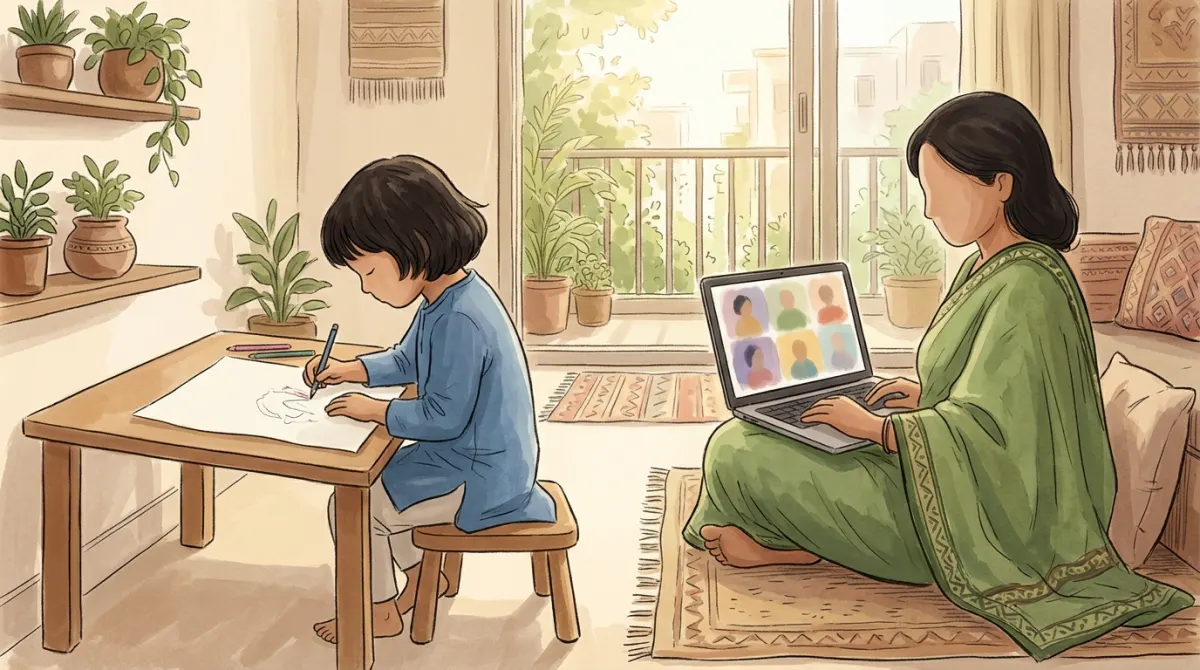
An online child psychologist is a mental health professional who sees children and teenagers by video, audio or chat. They help with emotional, behavioural or social difficulties. Mayo Clinic Press lists three common reasons for seeking this help. These are general support with life stressors, a specific concern, or therapy after a mental health diagnosis. In most families, the first step is a parent's conversation about what they have noticed.
Many parents wonder whether a screen can work for a child. Mayo Clinic Press notes that data shows online therapy can be just as successful. It also says online therapy can be difficult with really young children. Kids who struggle to engage may also find it hard. It is decided case by case. So it suits many children, but not every child.
It is hard to tell normal development from a real concern. NIMH advises considering help if your child's behaviour or emotions last for weeks or longer. Official Indian data on younger children is also limited. India's National Mental Health Survey 2015-16 did not include children under 13. That is no reason to wait if something worries you.
A psychologist offers therapy and guidance, not medicines. If your child needs an opinion on medicines, a psychiatrist or doctor can help. This follows India's Telemedicine Practice Guidelines 2020. For the wider topic, see our psychologist consultation page.
Child Psychologist, Psychiatrist, School Counsellor or Doctor: Who Should You See?
Each helps in a different way. The right first step depends on your child's concern.
How an Online Child Psychology Consultation Works, Step by Step
What to look for, what is treated, and what parents do in between sessions.
When Should Parents Consult a Child Psychologist Online?
Every child has bad days. The difficulty is telling normal growing-up from something that needs support. NIMH advises considering help if a child's behaviour or emotions last for weeks or longer. Younger children often show distress through the body or behaviour rather than words. Older children may withdraw, lose energy or take risks. You do not need a diagnosis to book. A first consultation is a safe place to ask whether this is something to watch or something to act on.
- Frequent tantrums
- Often fearful or worried
- Frequent stomachaches or headaches with no known medical cause
- Sleeping too much or too little, or frequent nightmares
- Difficulty making friends or avoiding social activities
- Struggling academically
- Low energy, or risky or destructive behaviour in older children
- Constant motion
Childhood and Teen Concerns Addressed in Online Sessions
Online sessions suit many everyday concerns. They help parents understand the issue and learn practical steps. You can also decide if more help is needed. They are not a replacement for a formal evaluation. If a concern needs testing, the psychologist will say so honestly. The table shows common areas and what a consultation can do.
| Area | What parents may notice | What a session can do |
|---|---|---|
| Worry and fears | Fearful, worried, stomachaches, clinging | Talk through triggers and teach coping skills |
| Behaviour | Frequent tantrums, constant motion, risky behaviour | Guide parents on routines and responses at home |
| School stress | Struggling academically, avoiding social activities | Explore causes and support the child |
| Life stressors | Low energy, sleep changes, frequent nightmares | Give a safe space to talk and cope |
How Online Child Psychology Differs by Age Group
A five-year-old and a fifteen-year-old need very different sessions. Mayo Clinic Press says online therapy can be hard with really young children. The approach is decided case by case. In general, the younger the child, the more the work goes through parents. As children grow, the psychologist speaks with them directly. Teenagers are usually told how privacy works and when safety may require parents to be told. This is a general guide, and every child is different.
| Age | How sessions usually run | Parent's role |
|---|---|---|
| 3-6 years | Short, activity-based, with parents nearby; most guidance goes to parents | Main partner: routines, observation and trying strategies |
| 7-12 years | Conversation mixed with drawing, games and building words for feelings | Joins for the debrief and supports practice at home |
| 13-18 years | Individual talk, looking at unhelpful thinking and building self-advocacy | Shares concerns early; respects the teen's private space |
Therapeutic Approaches Used in Virtual Child Therapy
Psychologists deliver evidence-based treatments like Cognitive Behavioral Therapy (CBT). NIMH says good treatment often includes parent involvement. It also teaches the child skills to practise at home or school. Tracking measures of progress is another important part. These ideas work well online because much of the practice happens in your own home. Your psychologist may add other methods depending on your child.
What Happens in an Online Child Psychologist Session?
The first session is almost always an intake. It often takes a session or two for therapy to really get going. A comprehensive evaluation usually begins with a parent interview about developmental history. It may also include information from school and an interview with the child. Mayo Clinic Press suggests trying a therapist for 2 to 3 sessions to check the fit.
- Parent intake — You share developmental history, daily routines and what worries you, usually without the child listening in.
- Child session — The child joins by video, audio or chat in a way suited to their age and comfort.
- Parent debrief — The psychologist explains what they noticed and agrees simple strategies for home.
- Follow-up review — You check progress, adjust the plan and decide whether more sessions or other help is needed.
The Role of Parents in Online Child Therapy
Parents are central to a child's progress. NIMH lists parent involvement and home practice as part of good treatment. For younger children, a parent often sits nearby or joins part of the session. For older children and teenagers, a private conversation can help them speak openly. The psychologist will explain what stays between them and the child. They will also explain that safety concerns may need to be shared. Between sessions, parents may be asked to try small changes.
How to Prepare Your Child for the First Online Session
A calm start makes a big difference. Explain the session as a chance to talk with someone who helps children. Do not present it as punishment or as a sign that something is wrong. Choose a quiet corner where siblings and the TV will not interrupt. Check your connection a few minutes early. Keep paper and colours nearby. Younger children often find it easier to draw than to explain.
- Tell your child this is a chat to help with worries or feelings
- Avoid words like 'sick', 'problem' or 'punishment'
- Choose a quiet corner away from TV and siblings
- Charge the phone or laptop and check the connection
- Keep paper, pencils or colours nearby
- Note down your questions and the changes you have seen
- Plan something calm for your child afterwards
Clinical Scope and Safety: When Online-Only Care Is Not Enough
Online care helps many families, but it has limits. VinsHealth is not an emergency service and runs from 10 AM to 6 PM. It does not do tests, procedures or in-person visits. If your child talks about wanting to hurt themselves or someone else, or their behaviour is unsafe, seek help immediately. Call 112, go to the nearest hospital, or reach Tele-MANAS on 14416, free and open 24x7. Formal testing for learning concerns needs in-person assessment.
How Much Does a Child Psychologist Cost in India?
Private fees vary by city. Our fee is fixed, with no mandatory packs.
| What it covers | Typical range |
|---|---|
| Private child psychologist session in a major city (Delhi, Mumbai, Bengaluru, Hyderabad) | Typically Rs 1,000 to Rs 2,800 per session |
| Travel, waiting time and a missed school day | Extra for an in-person visit |
| VinsHealth online consultation (video, audio or chat) | ₹500 (fixed) |
City ranges are typical private fees and vary by clinic and psychologist.
You pay only for the consultation you book. There is no subscription.
How to Book an Online Child Psychologist at VinsHealth
Who You Will Speak To
Sessions on VinsHealth are taken by qualified psychologists from our own team. You can ask for your psychologist’s qualifications and registration details before your session.
Why Indian Families Choose Online Child Psychology
Online Child Psychologist for Families in Your City
Consultations are online and available across India. We do not run in-person clinics.
Frequently Asked Questions About Online Child Psychologists
Sources and Further Reading
- What kind of therapy is right for my child? — Mayo Clinic Press
- How do I find the right therapist for my child? — Mayo Clinic Press
- Children and Mental Health — NIMH
- Child mental health professionals and psychoeducational assessment — PubMed Central
- Medical facts on this page come from 4 trusted sources (Mayo Clinic Press, NIMH, PubMed Central), listed under Sources.
- Drafted with AI assistance, then checked by a separate editorial review against those sources and Google’s guidelines for health content.
- Before publishing, an independent fact-check by a different AI system compared the numbers and medical claims with the sources, the source links were tested, and the text was checked for originality.
- Not yet reviewed by a doctor. Reviewed pages show the reviewer’s name and registration number at the top.
- No doctor names, ratings or patient numbers are shown unless they are real and can be checked. Spotted a mistake? Write to us and we will correct it.
This page gives general information about mental health and counselling. It is not a diagnosis or a substitute for an in-person assessment. If you are in danger, call 112 or Tele-MANAS 14416. Last updated: 2 November 2026.
Ready to Talk to a Child Psychologist?
Share your child's concern and pay ₹500. A psychologist will usually connect with you within 1 hour, between 10 AM and 6 PM.