Obsessive-Compulsive Disorder (OCD)
: Symptoms, Causes, and Clinical Care
If uncontrollable and recurring thoughts or repetitive behaviors are taking over your day, you are not alone. A psychiatrist can listen, evaluate your symptoms, and discuss treatment options. Book a private video, audio, or chat consultation, usually connected within 1 hour of payment.
What Is OCD and How Is It Different From Habits?
Obsessive-compulsive disorder (OCD) is a long-lasting disorder in which a person experiences uncontrollable and recurring thoughts (obsessions), engages in repetitive behaviors (compulsions), or both. These symptoms get in the way of daily activities and cause distress. Treatments like cognitive behavioral therapy and medicines help people manage their symptoms.

Obsessive-compulsive disorder (OCD) is a long-lasting disorder in which a person experiences uncontrollable and recurring thoughts (obsessions), engages in repetitive behaviors (compulsions), or both. Obsessions are intrusive, unwanted thoughts, urges, or mental images that make most people anxious. Compulsions are repetitive behaviors a person feels the urge to do, often in response to an obsession.
The word 'unwanted' matters. People with this condition do not choose the thoughts, and many find them upsetting. Having such thoughts is a symptom of a medical condition, and treatments help people manage their symptoms.
In India, the National Mental Health Survey 2015-16 reported a prevalence of 0.8% for OCD. An earlier study, discussed in a review in the Indian Journal of Psychiatry, found a lifetime prevalence of 0.6%. Across a country as large as ours, that is a great many people, and many of them suffer quietly.
OCD is often misunderstood as simply being neat or organized. MedlinePlus calls this a myth: cleaning can be one symptom, but the condition more often involves getting stuck on an action you feel compelled to repeat. A psychiatrist can help you work out whether what you are living with is OCD, and what to do next.
Psychiatrist, Psychologist or Family Doctor: Who Should You See for OCD?
Each professional does a different job. Many people need more than one.
OCD Symptoms, Diagnosis and Treatment Explained
What the condition looks like, how it is assessed, and what helps.
What Are the Common Symptoms of OCD?
OCD has two main parts: obsessions and compulsions. A person may experience one or both. Common themes include a fear of germs or contamination, aggressive thoughts toward others or oneself, and a desire to have things symmetrical or in perfect order. Compulsions are repetitive behaviors a person feels the urge to do, often in response to an obsession, such as excessive cleaning, handwashing, repeatedly checking things, or compulsive counting.
| Obsession (the unwanted thought) | Compulsion (the repeated response) |
|---|---|
| Fear of germs or contamination | Excessive cleaning or handwashing |
| Aggressive thoughts toward others or oneself | Repetitive behaviors felt as an urge in response |
| Desire to have things symmetrical or in perfect order | Compulsive counting or arranging |
How Does the OCD Cycle Turn Thoughts Into Rituals?
Understanding the loop helps explain why OCD is difficult to manage. A thought arrives, distress rises, a repetitive behavior follows, and a short calm comes. Because the compulsion seems to work temporarily, the urge often returns. A specific, highly effective type of cognitive behavioral therapy used for this is Exposure and Response Prevention (ERP).
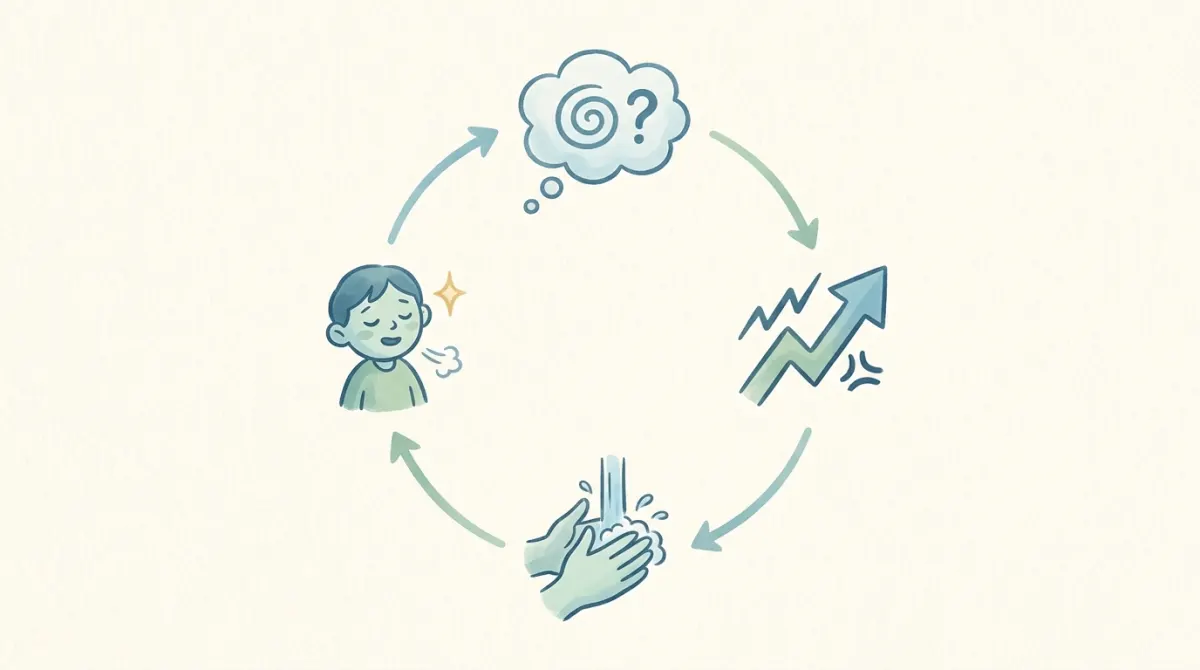
- An obsession appears — Intrusive, unwanted thoughts, urges, or mental images arrive.
- Distress rises — These recurring thoughts make most people anxious and cause distress.
- A compulsion is performed — You engage in repetitive behaviors, like checking or counting, in response.
- The loop repeats — The relief is temporary, and the obsessions and compulsions return, getting in the way of daily activities.
How Is OCD Different From Perfectionism and Neatness?
OCD is often misunderstood as simply being neat or organized. MedlinePlus notes it is a myth that OCD just means being neat. Cleaning can be one symptom, but the condition more often involves getting stuck on a particular action you feel compelled to repeat. Mayo Clinic adds there is a difference between being a perfectionist—someone who needs flawless results or performance—and having OCD.
| Core feature | Needing flawless results or performance | Uncontrollable and recurring thoughts or behaviors |
|---|---|---|
| The action | Simply staying organized | Getting stuck on an action you feel compelled to repeat |
| Impact on life | Usually manageable | Gets in the way of daily activities and causes a lot of distress |
What Triggers OCD and Why Is It Often Hidden?
People with OCD do not choose their intrusive thoughts, and the condition is not a character flaw. Shame is a significant barrier to getting help. NIMH notes that people with OCD may not tell their health care provider about their obsessions and compulsions out of fear of judgment. Preparing by tracking your symptoms and being ready to discuss them openly is an important first step.
How Is OCD Clinically Evaluated and Diagnosed?
A provider will do a physical exam and ask about your medical history to rule out other health problems. If your symptoms do not seem to be caused by a physical problem, your provider may do an OCD test or may refer you to a mental health specialist. An online consultation is an excellent way to discuss your medical history and symptoms with a psychiatrist.
- Medical history review — Your provider asks about your health to rule out physical problems.
- Symptom discussion — You describe your obsessions, compulsions, and how they affect daily activities.
- OCD testing — Your provider may do an OCD test to assess your symptoms.
- Specialist referral — If needed, you may be referred to a mental health specialist.
- Treatment planning — Your provider discusses options like cognitive behavioral therapy or medicines.
What Are the Evidence-Based Treatments for OCD?
Although there is no cure for OCD, treatments help people manage their symptoms. The main treatments are cognitive behavioral therapy (CBT), medicines, or both. A specific, highly effective type of CBT used is Exposure and Response Prevention (ERP). If medicines are prescribed, antidepressant treatment can take 8 to 12 weeks before symptoms begin to improve.
| Option | What it involves | Who provides it |
|---|---|---|
| Cognitive Behavioral Therapy (CBT) | Includes Exposure and Response Prevention (ERP) | Clinical psychologist |
| Medicines | Antidepressants, which can take 8-12 weeks to improve symptoms | Psychiatrist, only on prescription |
| Combined care | Using both CBT and medicines together for better management | Psychiatrist and psychologist |
When Should You Seek Professional Help for OCD?
Mayo Clinic advises that if your obsessions and compulsions affect your quality of life, you should see your doctor or mental health professional. You do not need to wait until symptoms are unbearable. A severe complication requiring immediate medical attention is having thoughts about suicide and behavior related to suicide. If this happens, call 112 or Tele-MANAS 14416 immediately.
- Obsessions and compulsions get in the way of daily activities.
- Symptoms cause a lot of distress or anxiety.
- You feel the urge to do repetitive behaviors in response to thoughts.
- You are hiding your symptoms out of fear of judgment.
- You have thoughts about suicide (requires immediate emergency care).
How to Consult a Psychiatrist Online for OCD
Who You Will Speak To
Psychiatry consultations on VinsHealth are taken by doctors with an MD or DNB in psychiatry. You can ask for your doctor’s medical council registration number before your consultation.
Why People Choose an Online Psychiatrist for OCD
Online Psychiatrist for OCD Near You
Consultations are online and available across India. VinsHealth has no clinics, so you can see a doctor from wherever you are.
Frequently Asked Questions About OCD
Sources and Further Reading
- Obsessive-Compulsive Disorder: When Unwanted Thoughts or Repetitive Behaviors Take Over — NIMH
- Obsessive-compulsive disorder (OCD) - Symptoms and causes — Mayo Clinic
- Obsessive-Compulsive Disorder — MedlinePlus
- Rehabilitation Council of India — Rehabilitation Council of India
- Review of Indian research on obsessive-compulsive disorder — Indian Journal of Psychiatry (PubMed Central)
- Medical facts on this page come from 5 trusted sources (NIMH, Mayo Clinic, MedlinePlus, Rehabilitation Council of India, Indian Journal of Psychiatry (PubMed Central)), listed under Sources.
- Drafted with AI assistance, then checked by a separate editorial review against those sources and Google’s guidelines for health content.
- Before publishing, an independent fact-check by a different AI system compared the numbers and medical claims with the sources, the source links were tested, and the text was checked for originality.
- Not yet reviewed by a doctor. Reviewed pages show the reviewer’s name and registration number at the top.
- No doctor names, ratings or patient numbers are shown unless they are real and can be checked. Spotted a mistake? Write to us and we will correct it.
This page gives general information about mental health and psychiatric care. It is not a diagnosis or prescription. Never stop or change a medicine without your doctor. If you are in danger, call 112 or Tele-MANAS 14416. Last updated: 24 November 2026.
Talk to a Psychiatrist About OCD Today
Consultations are online, from 10 AM to 6 PM, for ₹700. VinsHealth is not an emergency service. In a crisis, call 112 or Tele-MANAS 14416.